
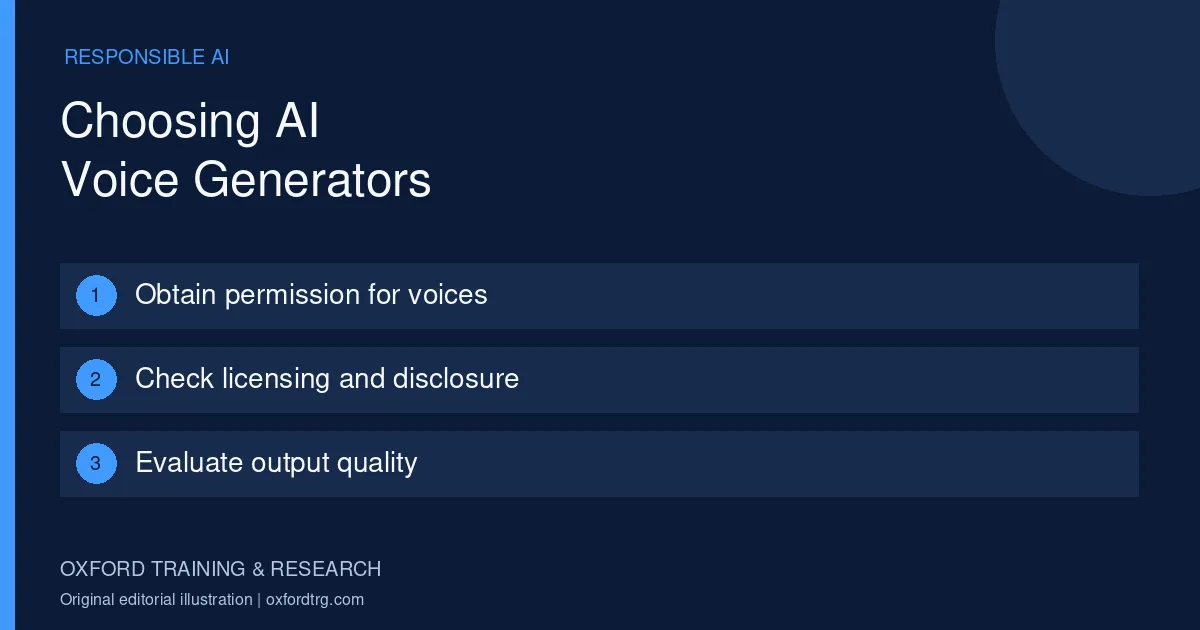
AI Voice Generators: Consent, Disclosure and Tool Selection
Evaluate synthetic-voice tools for your legitimate use case and obtain permission before imitating a real person’s voice.
On this page
- Choose an AI voice workflow around permission and purpose
AI voice generators can support drafts of narration, accessible alternatives and learning prototypes. Before comparing voices, identify the intended audience, distribution channel and rights attached to the recording. A privately reviewed storyboard and a public advertisement do not require the same approval process. - Prepare a script that works when heard
Read the script aloud before generating audio. Shorten long sentences, expand unfamiliar abbreviations and give the narrator a pronunciation list for names and technical terms. Write dates and quantities in the way they should be spoken, then check that meaning is preserved in the final recording. - Compare voices with a realistic sample
Use the same short passage for every candidate. Include a heading, a technical term, a number and a sentence where emphasis changes meaning. Listen on ordinary headphones and a phone speaker, not only on studio equipment. Ask a member of the intended audience whether the passage is understandable at normal playback speed. - Example: narration for an onboarding lesson
Imagine a fictional lesson teaching new staff how to report a system issue. The script contains a product name and an escalation address. The reviewer checks the spoken product name against the approved pronunciation and listens for confusion between “cannot sign in” and “can sign in.” A small missing word can reverse an instruction. - Keep human identity and synthetic output clear
When a synthetic voice could mislead listeners about who spoke or endorsed the message, provide a clear explanation appropriate to the context. Do not present generated narration as a genuine interview, customer testimonial or statement by someone who never recorded it. If you use a stock synthetic voice, retain the relevant licence record. - Design for revision and accessibility
Keep the approved script, pronunciation notes, audio version and export settings together. Choose file formats that your learning platform supports and test the actual playback page. Provide a readable transcript, suitable controls and a way to access the information without listening. - Put the guide to work
- Questions readers ask
- Reference routes and further reading
- Continue with a relevant guide
Choose an AI voice workflow around permission and purpose
AI voice generators can support drafts of narration, accessible alternatives and learning prototypes. Before comparing voices, identify the intended audience, distribution channel and rights attached to the recording. A privately reviewed storyboard and a public advertisement do not require the same approval process.
Do not assume that a recording found online can be cloned or that a familiar public voice is available for unrestricted use. For a real person’s voice, obtain appropriate permission covering the intended use. Check the tool’s current terms, the voice licence and applicable rules; this guide is a production checklist rather than legal advice.
Prepare a script that works when heard
Read the script aloud before generating audio. Shorten long sentences, expand unfamiliar abbreviations and give the narrator a pronunciation list for names and technical terms. Write dates and quantities in the way they should be spoken, then check that meaning is preserved in the final recording.
Separate content approval from voice styling. A clear voice cannot repair an inaccurate instruction. For training, obtain review of the procedure before spending time adjusting pace or emotion. This prevents repeated audio exports after a substantive policy correction.
Compare voices with a realistic sample
Use the same short passage for every candidate. Include a heading, a technical term, a number and a sentence where emphasis changes meaning. Listen on ordinary headphones and a phone speaker, not only on studio equipment. Ask a member of the intended audience whether the passage is understandable at normal playback speed.
Record pronunciation errors, unnatural pauses, inconsistent loudness and words that are omitted or repeated. Judge whether you can correct those issues through an ordinary supported workflow. A polished first paragraph is not enough if every later revision requires rebuilding the entire track.
Example: narration for an onboarding lesson
Imagine a fictional lesson teaching new staff how to report a system issue. The script contains a product name and an escalation address. The reviewer checks the spoken product name against the approved pronunciation and listens for confusion between “cannot sign in” and “can sign in.” A small missing word can reverse an instruction.
The team keeps a text transcript with the final audio and updates both when the procedure changes. Captions are checked against the approved script rather than accepted automatically. The audio is a second representation of the same instruction, not an independent source of policy.
Keep human identity and synthetic output clear
When a synthetic voice could mislead listeners about who spoke or endorsed the message, provide a clear explanation appropriate to the context. Do not present generated narration as a genuine interview, customer testimonial or statement by someone who never recorded it. If you use a stock synthetic voice, retain the relevant licence record.
Protect voice recordings and project files as personal or business data when appropriate. Limit who can upload samples, create new voices or export recordings. Agree how the voice is removed from a project when the permission ends or the narrator leaves the organisation.
Design for revision and accessibility
Keep the approved script, pronunciation notes, audio version and export settings together. Choose file formats that your learning platform supports and test the actual playback page. Provide a readable transcript, suitable controls and a way to access the information without listening.
Your final acceptance check should ask whether the narration is accurate, understandable, permitted and maintainable. “Sounds human” is not the only standard, and a voice that draws attention to itself may be less useful than a clear, consistent narration that helps the learner complete the task.
Put the guide to work
Use these five prompts to prepare a working record for your own situation. Record the evidence and unresolved questions rather than treating a completed checklist as certification.
- Rights. Identify the voice source and intended distribution. Keep the relevant permission or licence rather than assuming public availability permits reuse.
- Script. Read a short approved script aloud and note difficult names, numbers and abbreviations. Resolve content errors before generating final narration.
- Listening test. Use the same sample on ordinary playback equipment. Record omissions and pronunciation problems as well as subjective preferences about tone.
- Accessibility. Check the transcript against the final audio and test the playback controls. Ensure the essential instruction is available without listening.
- Revision record. Keep script, pronunciation notes, audio version and approval together. Recheck neighbouring audio whenever a short section is regenerated.
Questions readers ask
Can I clone a voice from a public recording?
Public availability does not establish permission for cloning or reuse. Obtain appropriate authorisation and check the relevant licence, service terms and applicable rules before using a real person’s voice.
Should synthetic training narration have a transcript?
Provide a readable equivalent of the approved information and check it against the final audio. This helps people who cannot listen and makes future corrections easier to maintain.
What should I check after regenerating a short audio section?
Check the edited section, its transition into neighbouring audio and the final transcript. A local correction can introduce a pronunciation, pacing or continuity issue elsewhere in the assembled recording.
Reference routes and further reading
Use the named organisations for current rules, product details or supporting guidance. External resources have their own scope and jurisdiction; they do not endorse this article.
Editorial drafting used AI assistance. Examples labelled fictional or constructed are teaching examples, not client results. The original author record is retained; no independent specialist review is claimed.

You may also like


Google Contact Center AI: Planning an Implementation