
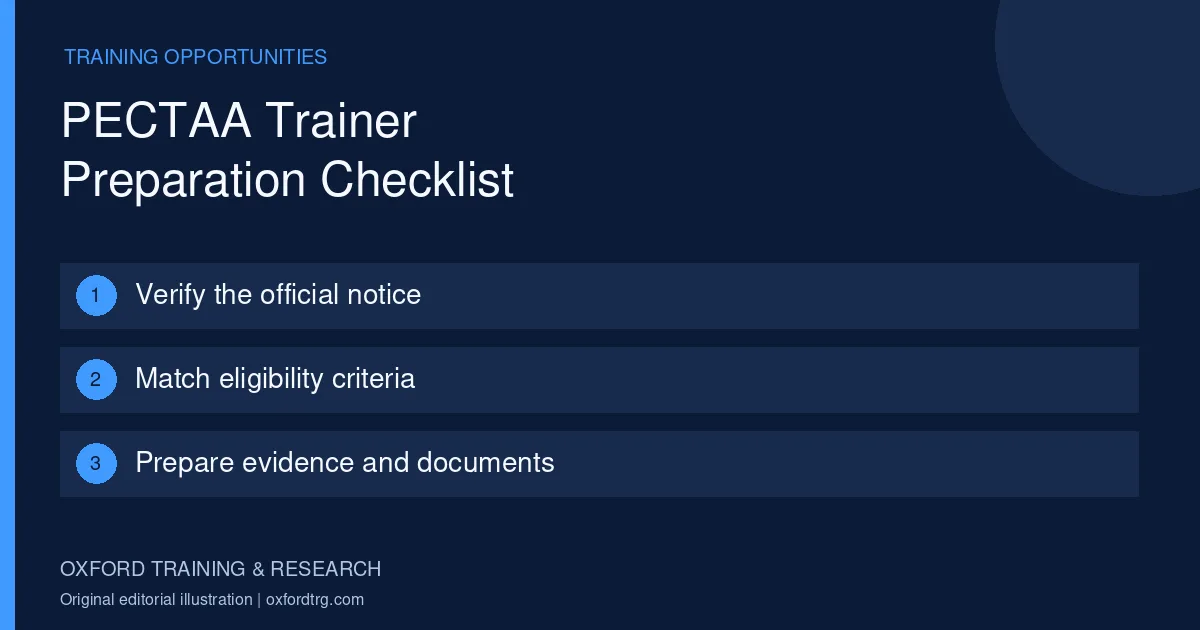
PECTAA Trainer Opportunities: How to Verify and Prepare
PECTAA is the Punjab Education, Curriculum, Training and Assessment Authority. Use its official notices to verify current roles, eligibility and application.
On this page
- Verify a PECTAA trainer opportunity before applying
PECTAA stands for the Punjab Education, Curriculum, Training and Assessment Authority. When searching for a trainer opportunity, use the authority’s official website and the exact current notice. Do not rely on an old article’s application instructions or confuse a trainer role with a different administrative or technical vacancy. - Read the notice as a set of requirements
Record the title, reference, issue date, role and issuing authority. Open all relevant attachments and look for later corrections. Identify whether the process concerns employment, a resource-person panel, a training assignment or another arrangement. Those distinctions affect what evidence and commitment may be required. - Prepare a truthful trainer profile
Present qualifications, relevant experience and a small selection of training evidence. Explain your role in collaborative work. For each example, state the audience, learning objective, delivery approach and what evidence was collected. Avoid claiming that attendance or satisfaction alone proved improved classroom performance. - Example: matching experience to an announced role
Imagine a fictional notice asks applicants to demonstrate experience supporting teachers with formative assessment. A candidate has delivered general motivational sessions and separately designed a lesson that checks misconceptions. The candidate should describe each accurately rather than relabelling every past session as assessment training. - Rehearse a focused facilitation demonstration
Choose a bounded skill and give participants something to attempt. Model one decision, provide practice and check the resulting work against a clear criterion. Plan instructions and timing, including the time learners need to think. Prepare an offline alternative if the environment is uncertain. - Submit and retain the official record
Follow the route linked from the verified notice, confirm file requirements and retain the acknowledgement where provided. Do not send personal documents to unrelated intermediaries or assume payment to an unofficial contact improves selection prospects. Check for amendments before the relevant deadline. - Put the guide to work
- Questions readers ask
- Reference routes and further reading
- Continue with a relevant guide
Verify a PECTAA trainer opportunity before applying
PECTAA stands for the Punjab Education, Curriculum, Training and Assessment Authority. When searching for a trainer opportunity, use the authority’s official website and the exact current notice. Do not rely on an old article’s application instructions or confuse a trainer role with a different administrative or technical vacancy.
This guide does not claim that a trainer recruitment round is currently open. A jobs page can contain other positions, historical documents or results. The notice relevant to your intended role determines the deadline, eligibility, documents and application route.
Read the notice as a set of requirements
Record the title, reference, issue date, role and issuing authority. Open all relevant attachments and look for later corrections. Identify whether the process concerns employment, a resource-person panel, a training assignment or another arrangement. Those distinctions affect what evidence and commitment may be required.
Make a table with the requirement, your evidence and the source wording. Do not infer an age limit, salary or experience threshold from an unrelated vacancy on the same website. If wording is ambiguous, obtain clarification from the official contact and preserve the answer with the notice.
Prepare a truthful trainer profile
Present qualifications, relevant experience and a small selection of training evidence. Explain your role in collaborative work. For each example, state the audience, learning objective, delivery approach and what evidence was collected. Avoid claiming that attendance or satisfaction alone proved improved classroom performance.
Use authorised materials and remove private learner information. If you create a demonstration specifically for the application, label it as a sample. A well-designed sample can demonstrate your approach without inventing a past client, an endorsement or a programme outcome.
Example: matching experience to an announced role
Imagine a fictional notice asks applicants to demonstrate experience supporting teachers with formative assessment. A candidate has delivered general motivational sessions and separately designed a lesson that checks misconceptions. The candidate should describe each accurately rather than relabelling every past session as assessment training.
The portfolio could include the lesson objective, a sample question, expected responses and a plan for feedback. The candidate explains what was actually delivered and what remains a demonstration. This allows selectors to judge relevance without relying on inflated labels.
Rehearse a focused facilitation demonstration
Choose a bounded skill and give participants something to attempt. Model one decision, provide practice and check the resulting work against a clear criterion. Plan instructions and timing, including the time learners need to think. Prepare an offline alternative if the environment is uncertain.
Practise answering questions about your design choices. Explain why the activity fits the objective and how you would adapt it for a different audience. If a question requires policy or subject expertise you do not have, state what you would verify rather than improvising an authoritative answer.
Submit and retain the official record
Follow the route linked from the verified notice, confirm file requirements and retain the acknowledgement where provided. Do not send personal documents to unrelated intermediaries or assume payment to an unofficial contact improves selection prospects. Check for amendments before the relevant deadline.
Keep the distinction between preparation and an active application visible when sharing this guide. A useful trainer article should help applicants verify evidence and present their work clearly, while leaving current recruitment facts to the authority that actually issues them.
Put the guide to work
Use these five prompts to prepare a working record for your own situation. Record the evidence and unresolved questions rather than treating a completed checklist as certification.
- Authority. Use the correct PECTAA name and the actual notice for the role. Do not transfer conditions from a different vacancy on the same website.
- Source record. Save title, reference, issue date and corrections. Identify whether the process is employment, an assignment or another arrangement before preparing the application.
- Evidence. Map the stated requirements to accurate qualifications and experience. Obtain official clarification where wording materially affects eligibility.
- Demonstration. Prepare a bounded activity with model, practice and feedback. Label samples and avoid implying that a fictional exercise was a commissioned programme.
- Submission. Follow the verified official destination and retain confirmation where provided. Keep current recruitment claims separate from general preparation advice.
Questions readers ask
What does PECTAA stand for?
Punjab Education, Curriculum, Training and Assessment Authority. Verify the exact opportunity and issuing notice rather than relying on an older article’s description.
Does the official jobs page mean a trainer round is open?
Not necessarily. Read the actual position and notice. A page can list different roles, historical information or results rather than the opportunity you want.
What belongs in a trainer portfolio?
Use relevant authorised samples showing objectives, practice, feedback and your role. Distinguish actual delivered work from a labelled demonstration and avoid unsupported impact claims.
Reference routes and further reading
Use the named organisations for current rules, product details or supporting guidance. External resources have their own scope and jurisdiction; they do not endorse this article.
Editorial drafting used AI assistance. Examples labelled fictional or constructed are teaching examples, not client results. The original author record is retained; no independent specialist review is claimed.