
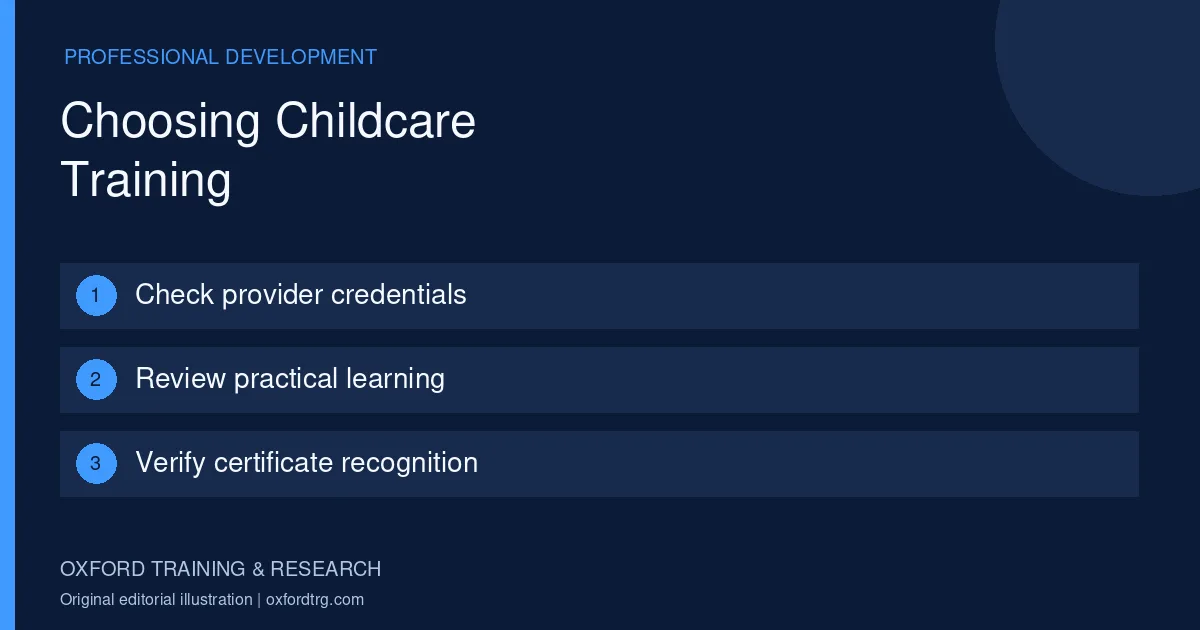
Choosing Childcare Training with a Certificate
Compare course content, practical assessment and recognition requirements before enrolling in a childcare programme advertised as free.
On this page
- Choose childcare training for the work it prepares you to do
Childcare training with a certificate can serve different purposes: introductory learning, workplace development, a recognised qualification or a requirement for a particular role. These are not interchangeable. Before enrolling, identify the role, location and employer or regulator whose requirements you need to meet. - Compare the learning outcomes with the role
Read what learners are expected to do after the course. Look for clear coverage relevant to the age group and setting, such as responsive interaction, safe routines, observation and communication with families. Do not assume that a broad course title includes every subject your role requires. - Examine assessment and learner support
Ask how the provider checks learning. A simple knowledge quiz, an observed task and a supervised placement provide different evidence. Find out who assesses the work, what happens after an unsuccessful attempt and how learners can obtain help with a difficult topic. - Example: comparing two course offers
A fictional applicant wants to work in a local early-years setting. One course offers a short awareness certificate after a multiple-choice quiz; another describes assessed practical work and a qualification recognised for a specified local purpose. The applicant asks the intended employer which evidence is required. - Check the provider’s claims and conditions
Confirm the provider’s identity, contact route, fees, assessment arrangements and cancellation terms. Verify any awarding or accreditation claim with the named organisation. Be cautious when a seller refuses to identify the body supposedly recognising the qualification. - Plan how learning will transfer into practice
Discuss with a supervisor how the learning will be used, observed and supported. Keep a record of completed training and any renewal requirement relevant to the actual qualification. Ask for feedback on practice rather than treating the certificate as the end of professional development. - Put the guide to work
- Questions readers ask
- Reference routes and further reading
- Continue with a relevant guide
Choose childcare training for the work it prepares you to do
Childcare training with a certificate can serve different purposes: introductory learning, workplace development, a recognised qualification or a requirement for a particular role. These are not interchangeable. Before enrolling, identify the role, location and employer or regulator whose requirements you need to meet.
A downloadable completion certificate does not automatically establish professional competence, accreditation or eligibility for employment. Verify recognition directly with the relevant body rather than relying on a provider’s logo collection or an ambiguous phrase such as “internationally approved.”
Compare the learning outcomes with the role
Read what learners are expected to do after the course. Look for clear coverage relevant to the age group and setting, such as responsive interaction, safe routines, observation and communication with families. Do not assume that a broad course title includes every subject your role requires.
Review safeguarding and practical-skill requirements through appropriate local guidance. An online awareness lesson may support knowledge while leaving supervised practice or a separate assessment necessary. The course should describe these boundaries instead of suggesting that watching videos proves readiness for every childcare responsibility.
Examine assessment and learner support
Ask how the provider checks learning. A simple knowledge quiz, an observed task and a supervised placement provide different evidence. Find out who assesses the work, what happens after an unsuccessful attempt and how learners can obtain help with a difficult topic.
Inspect a sample lesson where possible. Are instructions clear, resources accessible and examples appropriate to the learners’ context? Check language, captions, screen readability and device requirements before paying. The cheapest option can become unsuitable if you cannot access the learning or complete the required assessment.
Example: comparing two course offers
A fictional applicant wants to work in a local early-years setting. One course offers a short awareness certificate after a multiple-choice quiz; another describes assessed practical work and a qualification recognised for a specified local purpose. The applicant asks the intended employer which evidence is required.
The answer may show that the first course is useful preparation but does not satisfy the employment requirement. That does not make the introductory course worthless; it makes its purpose different. A good decision matches the course to the required outcome instead of choosing the most impressive certificate design.
Check the provider’s claims and conditions
Confirm the provider’s identity, contact route, fees, assessment arrangements and cancellation terms. Verify any awarding or accreditation claim with the named organisation. Be cautious when a seller refuses to identify the body supposedly recognising the qualification.
Review what personal information is required and how practical evidence involving children is handled. Do not upload photographs, observations or identifiable records without appropriate authorisation and safeguards. A course assignment does not remove the privacy and protection duties of the setting.
Plan how learning will transfer into practice
Discuss with a supervisor how the learning will be used, observed and supported. Keep a record of completed training and any renewal requirement relevant to the actual qualification. Ask for feedback on practice rather than treating the certificate as the end of professional development.
UNICEF’s early-childhood resources provide useful context about responsive caregiving and children’s development, but they do not certify a commercial course. Use broad educational resources to inform your questions, then verify the specific training and recognition requirements through the appropriate local authority or employer.
Put the guide to work
Use these five prompts to prepare a working record for your own situation. Record the evidence and unresolved questions rather than treating a completed checklist as certification.
- Purpose. Identify the intended role and jurisdiction before selecting training. Ask the employer or relevant body which qualification or practical evidence is actually required.
- Recognition. Verify the named awarding or accreditation claim directly. A completion certificate and a recognised employment qualification may serve different purposes.
- Learning. Compare outcomes, assessment and learner support. Check whether practical competence is observed or whether the course provides awareness learning only.
- Access. Try a sample on the device you will use. Review language, captions, instructions and the resources needed to finish the assessment.
- Application. Agree with a supervisor how learning will be used and checked. Protect children’s information when completing any practical assignment or observation record.
Questions readers ask
Does any childcare certificate qualify me for employment?
No. Recognition depends on the role, employer, jurisdiction and qualification. Verify the specific requirement with the appropriate body before enrolling.
Can an online course prove practical competence?
It depends on its assessment and the applicable requirement. A video course or knowledge quiz should not be assumed to replace supervised practice or an observed assessment.
Should I upload real children’s records for an assignment?
Only with appropriate authorisation and safeguards. A training assignment does not remove the privacy and protection responsibilities of the setting.
Reference routes and further reading
Use the named organisations for current rules, product details or supporting guidance. External resources have their own scope and jurisdiction; they do not endorse this article.
Editorial drafting used AI assistance. Examples labelled fictional or constructed are teaching examples, not client results. The original author record is retained; no independent specialist review is claimed.

You may also like


Managing Freelance Disputes with Clear Records
