
Outsourcing Software Development: A Buyer’s Checklist
Evaluate an outsourcing partner through evidence of delivery, a bounded trial and clear ownership and acceptance terms.
On this page
- Outsource a software outcome, not an undefined wish list
Outsourcing software development works better when the buyer can describe the problem and evaluate the result. Before approaching suppliers, identify the users, the task they need to complete and the systems the software must connect to. Decide whether a custom build is necessary or whether an existing product already meets the requirement. - Prepare evidence of the workflow
Document the current process with an example from start to finish. List the inputs, decisions, exceptions and expected outputs. Use authorised fictional or anonymised records for evaluation. Include the cases that currently create rework rather than presenting only the ideal path. - Compare proposals on the same boundaries
Give shortlisted suppliers the same brief and ask them to identify assumptions and exclusions. Compare who performs discovery, design, testing, deployment, documentation and maintenance. A proposal that excludes migration or support should not be compared as if those services were included. - Example: an enrolment dashboard
In a fictional project, a training provider needs to import participant lists, check duplicate records and issue attendance reports. The first milestone is a small prototype using constructed data. Staff test a duplicate name, a missing email, an incorrect date and a user with limited permissions. - Retain practical control of the system
Agree ownership and access for the source repository, hosting account, domain, deployment configuration and third-party services. Use organisation-controlled accounts where appropriate, with individual access for suppliers. Avoid a production system that depends on a developer’s personal account or an undocumented secret. - Make handover a tested deliverable
Require usable setup instructions, configuration documentation, known limitations and a maintenance plan. Have someone other than the primary developer follow the handover instructions in an appropriate test environment. A repository containing code is not the same as an operable service. - Put the guide to work
- Questions readers ask
- Reference routes and further reading
- Continue with a relevant guide
Outsource a software outcome, not an undefined wish list
Outsourcing software development works better when the buyer can describe the problem and evaluate the result. Before approaching suppliers, identify the users, the task they need to complete and the systems the software must connect to. Decide whether a custom build is necessary or whether an existing product already meets the requirement.
A supplier may help clarify a solution, but the buyer still needs an accountable product owner. Someone must decide priorities, approve changes and confirm whether the delivered behaviour meets the organisation’s needs. Outsourcing coding does not outsource every business decision.
Prepare evidence of the workflow
Document the current process with an example from start to finish. List the inputs, decisions, exceptions and expected outputs. Use authorised fictional or anonymised records for evaluation. Include the cases that currently create rework rather than presenting only the ideal path.
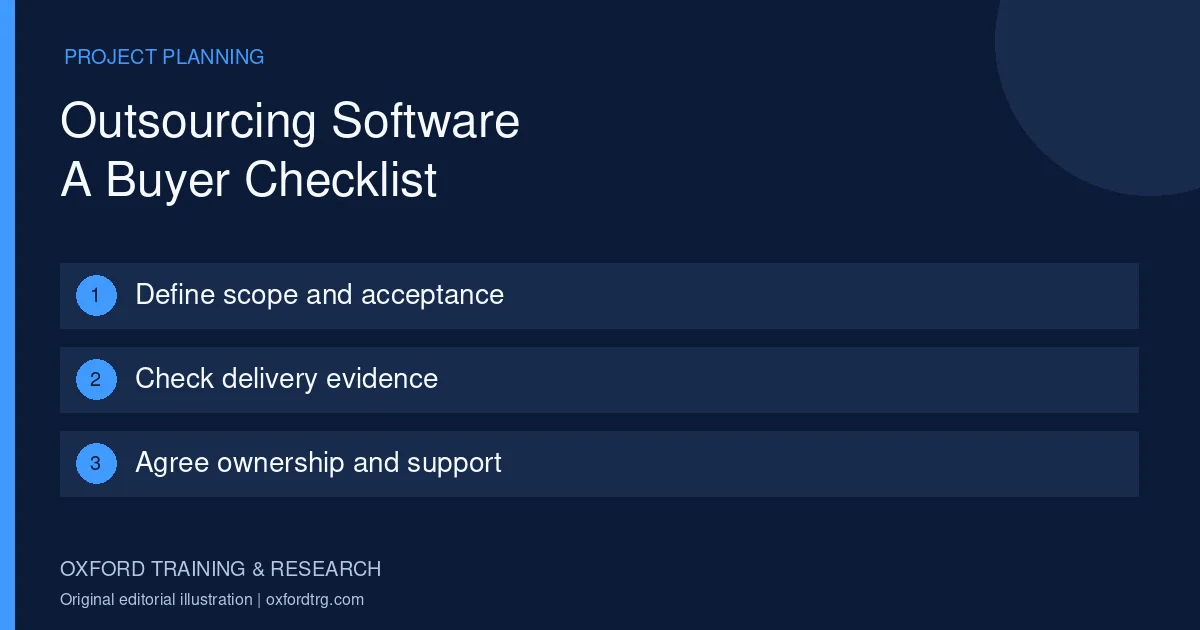
Turn requirements into observable acceptance criteria. “Easy reporting” is vague. “An authorised coordinator can export completed enrolments for a selected date range without exposing other departments’ records” is testable. Add relevant accessibility, security and recovery requirements, with specialist review where needed.
Compare proposals on the same boundaries
Give shortlisted suppliers the same brief and ask them to identify assumptions and exclusions. Compare who performs discovery, design, testing, deployment, documentation and maintenance. A proposal that excludes migration or support should not be compared as if those services were included.
Ask to see evidence relevant to your type of project and clarify who did the work. Respect confidentiality: a supplier should not be expected to reveal another client’s private system. A suitable sample or reference can still demonstrate how the team handles requirements, testing and handoff.
Example: an enrolment dashboard
In a fictional project, a training provider needs to import participant lists, check duplicate records and issue attendance reports. The first milestone is a small prototype using constructed data. Staff test a duplicate name, a missing email, an incorrect date and a user with limited permissions.
The supplier records the expected behaviour for each case. This early milestone may reveal that the import rules are unclear before the entire interface is built. Payment milestones should correspond to agreed outputs, not merely to the passage of time or a screenshot of unfinished screens.
Retain practical control of the system
Agree ownership and access for the source repository, hosting account, domain, deployment configuration and third-party services. Use organisation-controlled accounts where appropriate, with individual access for suppliers. Avoid a production system that depends on a developer’s personal account or an undocumented secret.
Set expectations for reviewing dependencies, handling discovered vulnerabilities and correcting defects. Explain how a production incident is reported and who can restore a previous release. Contract terms and intellectual-property questions need appropriate local advice rather than assumptions copied from an internet template.
Make handover a tested deliverable
Require usable setup instructions, configuration documentation, known limitations and a maintenance plan. Have someone other than the primary developer follow the handover instructions in an appropriate test environment. A repository containing code is not the same as an operable service.
Before final acceptance, test the agreed user journeys, permissions, data migration and recovery procedure. Record any unresolved items and their owner. The strongest outsourcing relationship leaves your organisation able to operate and maintain the result, rather than dependent on informal knowledge held by one person.
Put the guide to work
Use these five prompts to prepare a working record for your own situation. Record the evidence and unresolved questions rather than treating a completed checklist as certification.
- Requirement. Write one end-to-end user journey and its exceptions. Use observable acceptance criteria instead of broad adjectives such as easy or professional.
- Supplier comparison. Give candidates the same boundaries and ask for assumptions. Check whether testing, migration, deployment, documentation and support are included or excluded.
- Milestone. Select an early output that tests an important assumption. Have intended users inspect it with constructed data before the complete build.
- Control. Document source, hosting, domain, configuration and service-account ownership. Keep the organisation able to operate the software without undocumented personal access.
- Handover. Test setup and recovery instructions with someone other than the primary developer. Record unresolved limitations and maintenance responsibility before final acceptance.
Questions readers ask
Does outsourcing remove the need for an internal product owner?
No. Someone in the buying organisation must set priorities, approve changes and judge acceptance against the business requirement.
Is receiving the source code a complete handover?
Not necessarily. The team also needs usable setup, configuration, deployment, maintenance and recovery information, together with the relevant account access.
Why use a small early milestone?
It tests important assumptions and working arrangements before the full build. Choose a meaningful user journey or prototype rather than a milestone that proves only that screens exist.
Reference routes and further reading
Use the named organisations for current rules, product details or supporting guidance. External resources have their own scope and jurisdiction; they do not endorse this article.
Editorial drafting used AI assistance. Examples labelled fictional or constructed are teaching examples, not client results. The original author record is retained; no independent specialist review is claimed.

You may also like
Choosing Free Active Directory Tools Responsibly